The Mechanics of UV Degradation in Polymers
When engineering equipment for long-term outdoor exposure—whether it is deep-sea mooring lines, heavy-duty lifting slings, or tactical outdoor gear—weathering is the ultimate test. Among all environmental factors, solar ultraviolet (UV) radiation is notorious for degrading synthetic polymers. It causes standard plastics to become brittle, lose color, and eventually snap under minimal stress. However, Ultra-High Molecular Weight Polyethylene (UHMWPE) fiber has earned a reputation for remarkable resilience in these exact conditions.
At Huidun UHMWPE, we frequently receive technical inquiries from overseas engineers and procurement managers asking: “How long will your fiber actually last under intense sunlight?” To answer this comprehensively, we need to examine the chemistry of UV degradation, how UHMWPE naturally handles solar radiation, and the proactive measures we take during manufacturing to guarantee extended longevity.
The Mechanics of UV Degradation in Polymers
To understand why UHMWPE outperforms other materials, it helps to understand what happens when sunlight hits a synthetic fiber. UV radiation consists of high-energy wavelengths that can penetrate the surface of a material. In many standard polymers, such as nylon or polyester, this energy matches the activation energy required to break the chemical bonds within the polymer backbone. This process, known as photo-oxidation, creates free radicals that rapidly break down the molecular chains, leading to a severe loss of tensile strength.
Aramid fibers, another common high-performance material, are highly sensitive to UV light. When exposed to sunlight, standard aramid undergoes a rapid discoloration and a significant reduction in breaking strength within a relatively short period, requiring protective jackets or coatings to survive outdoors.
Key Insight: Unlike nylon or polyester, UHMWPE’s purely hydrocarbon structure means it lacks the chromophore groups that absorb UV radiation — making it inherently more resistant to photo-oxidation from the molecular level up.
Why Raw UHMWPE Has an Inherent Advantage
UHMWPE approaches this problem with a major structural advantage. Chemically, it is a pure hydrocarbon consisting solely of carbon-carbon and carbon-hydrogen single bonds. Unlike aramids or polyesters, it contains no aromatic rings, amide linkages, or carbonyl groups—which act as “chromophores” (light-absorbing structures) that invite UV damage.
Because UHMWPE does not actively absorb UV wavelengths in the critical damage zones, the rate of photo-oxidation is fundamentally much slower. Combined with its incredibly high crystallinity (where over 80% of the molecules are tightly packed in a dense lattice), it is difficult for oxygen and UV rays to penetrate beyond the outer skin of the fiber. The core of a Huidun UHMWPE fiber remains protected and structurally sound long after other fibers would have degraded.
How Huidun Maximizes Outdoor Longevity
While raw UHMWPE is naturally resilient, industrial environments demand absolute certainty. At our advanced production facilities, Huidun UHMWPE applies specialized techniques to elevate this performance to the highest possible standard for extreme outdoor applications:
Advanced UV Stabilizers
During our proprietary gel-spinning process, we integrate specialized UV stabilizers directly into the polymer matrix. These compounds absorb harmful UV radiation and dissipate it harmlessly as low-grade heat before it can interact with the polyethylene chains.
High-Quality Coating Technologies
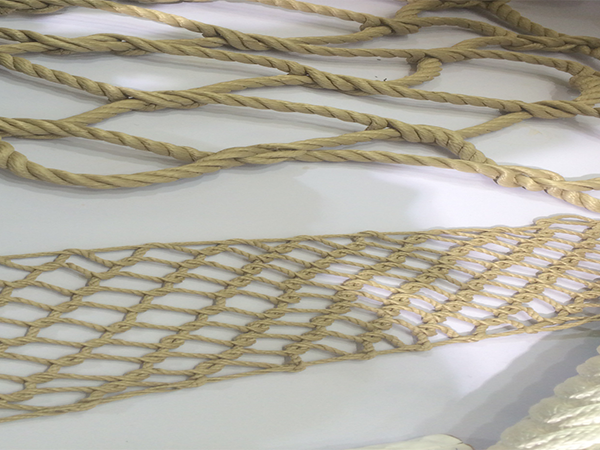
For ropes, cordage, and netting exposed to continuous marine environments, we utilize custom-formulated polyurethane coatings. These provide a dual layer of protection—shielding the fiber from both mechanical abrasion and direct UV exposure.
Optimized Fiber Density
By strictly controlling the molecular weight and drawing ratios during extrusion, we minimize surface micro-voids, leaving fewer areas where environmental oxidation can take root.
Predicting Longevity: What Factors Matter?
It is important to note that “longevity” is not a single fixed number; it depends entirely on the application context. When assessing how a Huidun fiber will perform over a multi-year lifecycle, engineers should consider three critical variables:
Geographical Location
UV intensity varies wildly. A mooring line deployed in the North Sea will experience a fraction of the annual UV radiation compared to an agricultural netting installation in equatorial regions or desert environments.
Fiber Thickness and Structure
Thicker braided ropes possess inherent self-shielding properties. The outer layers may experience minor surface oxidation over several years, but they effectively shield the inner load-bearing cores from light penetration.
Mechanical Stress
Fibers under constant, near-limit tension are more susceptible to accelerated environmental wear than those used in cyclic or low-stress operations. This is why proper safety factor calculations are vital during procurement.
Conclusion: Engineered for the Elements
Investing in high-performance materials is ultimately an exercise in risk management. Choosing a fiber that fails prematurely due to sunlight exposure leads to expensive downtime, replacement costs, and safety hazards. Through a combination of inherent molecular stability and advanced manufacturing additives, UHMWPE fiber represents one of the most reliable outdoor tension materials available today.
At Huidun UHMWPE, we don’t just manufacture fiber; we engineer longevity. We work closely with global clients to ensure our materials match the precise environmental demands of their final products, delivering peace of mind under the open sky.
Post time: May-27-2026